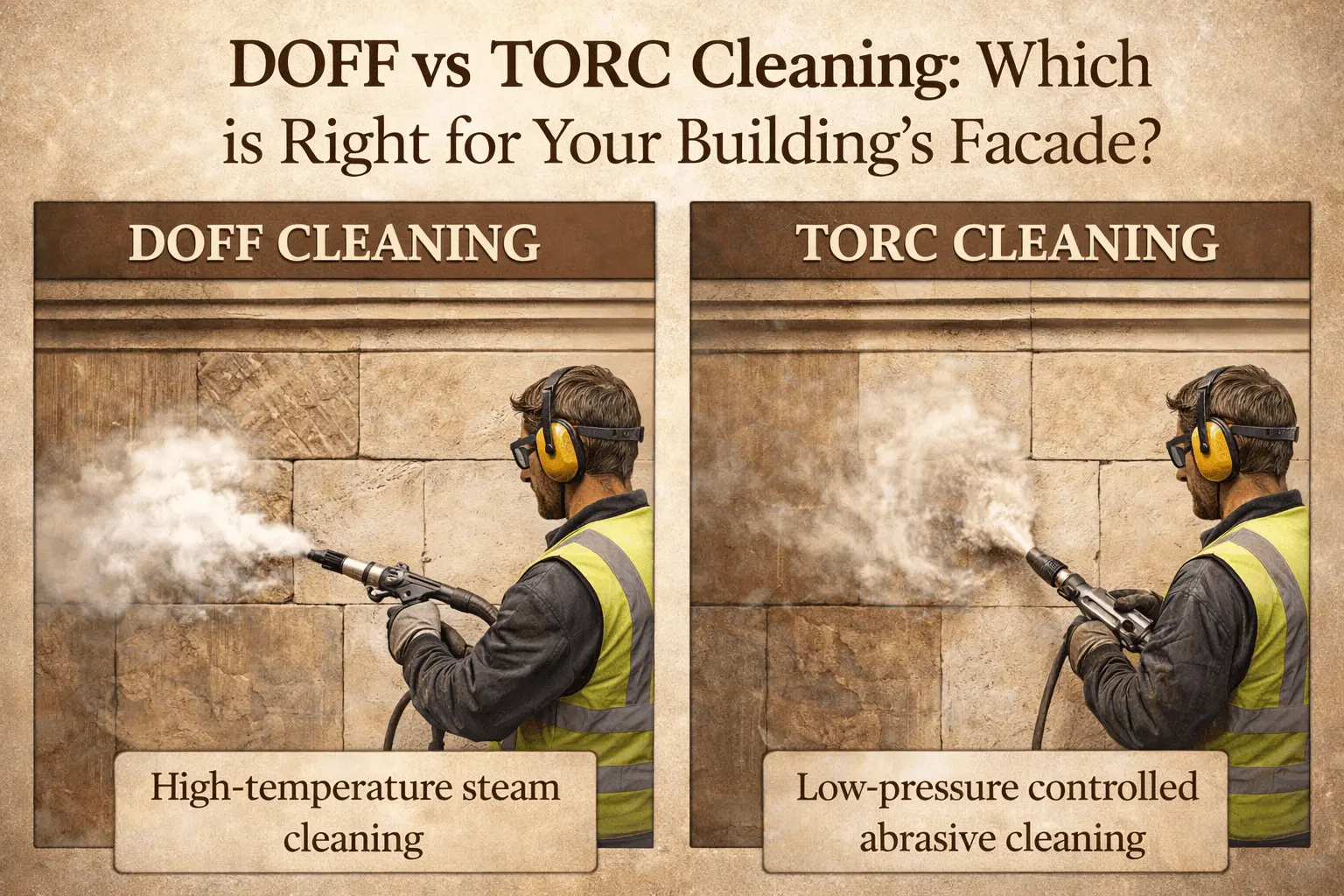
DOFF vs TORC Cleaning: Which is Right for Your Building’s Facade?
Cleaning a heritage building’s facade is a delicate balancing act. Remove too much and you damage irreplaceable stonework. Remove too little and pollution, biological growth, and grime continue their slow destruction.
For London’s Georgian terraces, Victorian monuments, and listed buildings, two systems have become the conservation standard: DOFF and TORC. Both are gentle, effective, and approved by English Heritage and conservation officers across the UK.
But they work in fundamentally different ways and excel in different situations. Whether you’re managing a Portland stone facade in Westminster or a sandstone terrace in Edinburgh, knowing which system suits your building could save you thousands and protect your heritage for decades to come.
DOFF Cleaning: The Superheated Steam System
How DOFF Works
DOFF cleaning uses superheated water essentially high-temperature steam reaching 150°C at the nozzle end. Unlike pressure washing, which relies on brute force, DOFF uses heat to do the work. The steam is delivered at low pressure, so there’s no risk of blasting away mortar or damaging soft stone.
Here’s what makes it effective: the superheated steam softens and lifts contaminants paint, biological growth, grime, pollution without scrubbing or chemicals. The heat also kills bacteria and spores, meaning moss and algae take longer to return compared to cold water methods.
The system dispenses only 5 litres of water per minute (about 300 litres per hour), so there’s minimal saturation. Stone dries in minutes, with no risk of water damage or frost issues. It’s gentle, chemical-free, and environmentally sound.
What DOFF Excels At
DOFF is highly effective at removing biological growth of moss, algae, lichen, and fungi that cling to damp stone and brick. It’s also excellent for paint removal (especially modern emulsions), graffiti, and general pollution grime.
Because it’s steam-based, it works well on a variety of surfaces: stone, brick, terracotta, glazed tiles, wood, and even concrete. Its gentle approach makes it perfect for delicate substrates like soft limestone, sandstone, and historic brickwork, where abrasive methods would cause permanent damage.
TORC Cleaning: The Gentle Vortex System
How TORC Works
TORC (The Orbital Rotational Cleaner) works on a completely different principle: the gentle swirling vortex. The system combines low-pressure compressed air (1-8 bars maximum), a fine inert granulate, and a controlled water mist.
These three elements pass through a modulated nozzle that creates a swirling vortex, think of it as a gentle spiral rather than a direct blast.
The granulate does the cleaning work. Common types include calcite (marble dust, great for most masonry), dolomite (more aggressive for heavy carbon), and unil (various grades for different tasks). The operator selects the granulate based on what needs removing and how delicate the surface is.
TORC uses remarkably little water: just 1.5 litres per minute (about 25 litres per hour), which is a fraction of DOFF’s water consumption.
The vortex action lifts contaminants gently, with no direct abrasive impact like traditional sandblasting. Interchangeable nozzles (5mm to 11mm) allow cleaning everything from intricate carved detail to large ashlar blocks.
What TORC Excels At
TORC is the specialist’s choice for heavy carbon sulphation, that black, crusty pollution buildup from decades of industrial soot. It’s also great for brittle or aged paint, limescale, and stubborn residues that DOFF struggles with.
Where TORC really shines is intricate detail work: carved capitals, rustication, decorative mouldings, and statues. The interchangeable nozzles let operators switch from a 5mm tip for delicate lettering to an 11mm nozzle for broad surfaces.
Its ultra-low water volume makes it ideal where saturation is a concern internal walls, fragile render, or water-sensitive structures. Conservation officers often specify TORC for listed buildings requiring the most sensitive touch.
The Key Differences at a Glance
Let’s compare the systems side-by-side to clarify which does what:
- Cleaning Method: DOFF uses thermal energy (superheated steam); TORC uses gentle abrasive action (vortex granulate).
- Temperature: DOFF operates at 150°C; TORC works at ambient temperature.
- Pressure: DOFF uses low water pressure; TORC uses low-medium air pressure (1-8 bars, adjustable).
- Water Volume: DOFF dispenses 5 litres per minute; TORC uses just 1.5 litres per minute—significantly less saturation risk.
- Speed: DOFF is faster on large, flat surfaces (walls, pavements). TORC is slower but offers precision control for detailed work.
- Ideal Uses: DOFF excels at moss, algae, fresh paint, and general pollution. TORC handles heavy carbon deposits, aged/brittle paint, limescale, and intricate carving.
- Consumables: DOFF requires only water. TORC needs granulate aggregates (ongoing cost, but minimal).
- Surface Impact: DOFF relies on heat (no abrasion). TORC uses ultra-fine abrasive action (gentler than sandblasting but more aggressive than steam alone).
Both are chemical-free, conservation-approved, and won’t damage properly identified substrates when used correctly.
4. Which System Should You Choose? Decision Criteria
Choosing between DOFF and TORC depends on what you’re cleaning and from what:
- For biological growth (moss, algae, lichen): DOFF is typically the better choice. The heat kills spores, meaning regrowth takes longer. It’s also faster on large areas like walls and pavements.
- For heavy industrial carbon deposits or aged brittle paint: TORC is more effective. The granulate abrasive action cuts through layers that steam alone struggles with.
- For very soft, friable stone (crumbling sandstone, soft limestone): DOFF’s pure steam is gentler—no abrasive contact whatsoever.
- For intricate carved detail: TORC’s interchangeable nozzles and precision control make it ideal for capitals, mouldings, and statues.
- For water-sensitive situations (internal walls, near electrics, fragile render): TORC uses 1/3 the water of DOFF significant advantage.
- For mixed contamination: Many projects use both. DOFF might handle general biological cleaning, while TORC tackles stubborn carbon deposits on decorative elements.
Critical: Always test first. Reputable contractors will conduct test patches with both systems to assess results before committing to full-scale cleaning. Every building, every stone type, every contaminant responds slightly differently.
5. London Heritage Buildings: Practical Applications
In London’s heritage landscape, both systems see regular use. Portland stone facades, like those on St Paul’s Cathedral or government buildings in Whitehall often require TORC cleaning to remove decades of industrial carbon sulphation. The fine granulate cuts through black crusts that steam alone can’t shift.
Victorian terraces with biological growth (that green-black staining on north-facing walls) typically respond beautifully to DOFF. The steam kills moss and algae efficiently, and the surface dries quickly which is crucial for London’s damp climate.
Bath stone on Georgian townhouses often benefits from a hybrid approach: TORC for intricate window surrounds and decorative details, DOFF for larger flat wall surfaces.
London stock brick (those yellow-brown bricks on millions of period properties) usually cleans well with DOFF unless there’s heavy carbon or paint involved.
If your building is in a conservation area or listed, consult your conservation officer before proceeding. They may have specific preferences based on local standards.
Conclusion
DOFF and TORC both represent the cutting edge of conservation-friendly cleaning worlds apart from the pressure washers and harsh chemicals that have damaged countless heritage buildings over the years.
DOFF’s superheated steam excels at biological growth and general cleaning with remarkable speed. TORC’s gentle vortex tackles stubborn carbon and detailed work with surgical precision.
The right choice depends on your building’s specific needs: what’s contaminating it, what it’s made of, and how delicate the surfaces are.
Don’t guess. Work with conservation-trained professionals who understand both systems, will test before proceeding, and can specify the approach that cleans effectively while protecting your London heritage for the next century.