
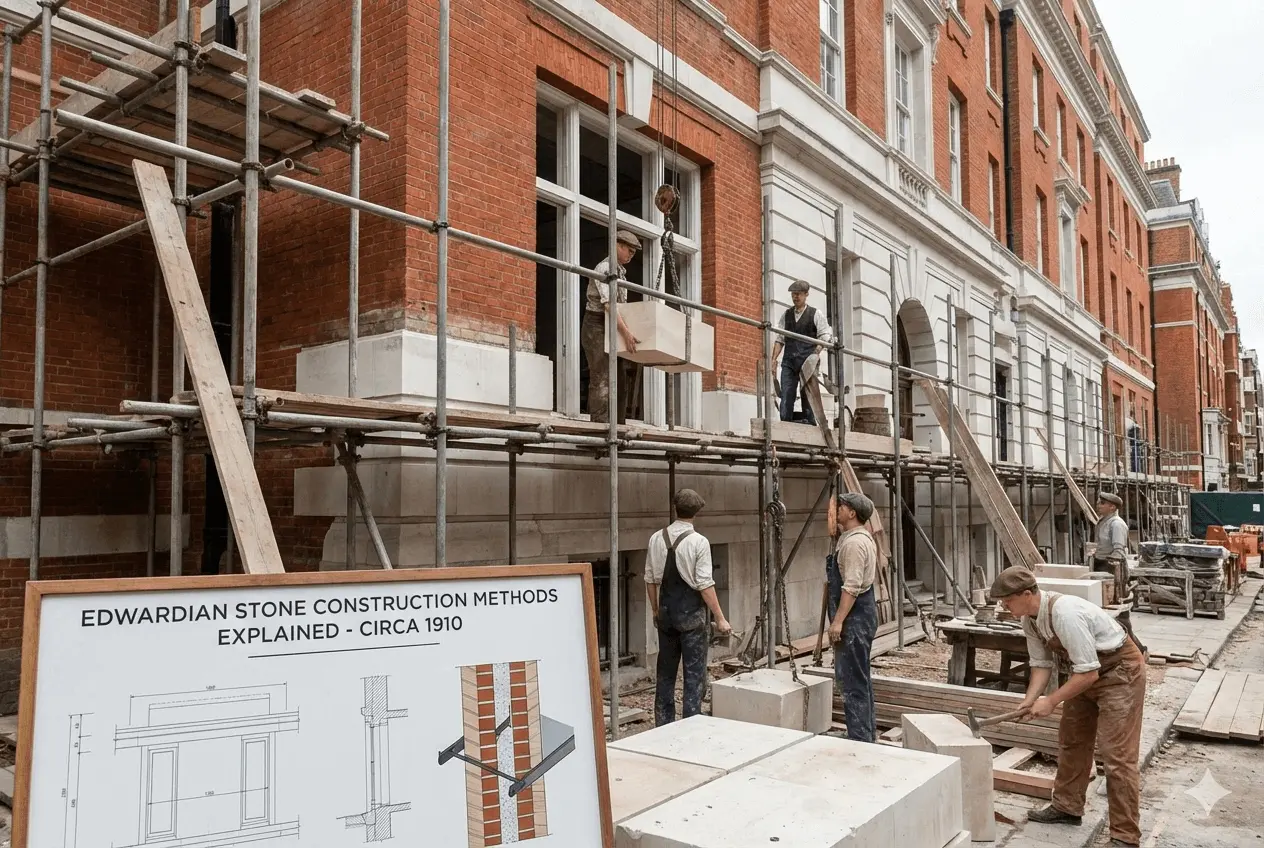
Edwardian Stone Construction Methods Explained
The Edwardian era (1901-1914) was brief, yet transformative for British architecture. Sandwiched between the ornate excesses of the Victorian period and the clean lines of modernism, it marked a pivotal shift in building construction.
With the rise of technological innovations like cavity walls and steel frames, the Edwardian period not only embraced craftsmanship but also revolutionized domestic building methods.
Arts & Crafts principles emphasized simplicity and local materials, challenging Victorian ornamentation and heralding a new architectural direction. Understanding the stone construction methods from this period is essential, especially for homeowners of Edwardian homes in London, where thousands of properties still stand today.
We’ll talk about the innovative building techniques of the time, the materials used, and how they shape modern maintenance needs.
The Edwardian Context
The Edwardian era was defined by a reaction against the excesses of the Victorian period. King Edward VII, influenced by French tastes, favored the lighter, more elegant designs of the 18th century.
In stark contrast to the heavy ornamentation of Victorian homes, Edwardian architecture emphasized simplicity and craftsmanship.
This shift was also driven by the Arts & Crafts movement, which prioritized handcrafted quality and the use of local materials, rejecting mass-produced Victorian adornments.
Technological advances such as electric lighting, gas appliances, and improved glass-making allowed for larger windows and more spacious interiors.
The growth of public transport and the rise of suburban living also contributed to the proliferation of middle-class homes in areas like Hampstead Garden Suburb and Bedford Park, leading to the development of garden suburbs.
Architecturally, there were two primary streams: Edwardian Baroque for public buildings like banks and museums, characterized by grand facades, rusticated stone, and ornate detailing; and simpler domestic architecture that reflected the period’s focus on comfort and practicality.
This duality between grandeur in public works and simplicity in residential buildings defined the Edwardian architectural landscape.
The Cavity Wall Revolution
Cavity walls were one of the most significant innovations in Edwardian domestic construction, replacing the solid walls common in Victorian homes.
Unlike the Victorian solid 9-inch walls made from a single layer of brick, Edwardian cavity walls featured two separate “leaves” of masonry.
The outer leaf was typically a decorative facing brick (often red or buff), exposed to the elements, while the inner leaf was made from common brick, forming the internal wall.
Between these leaves was an air gap or cavity, typically 50-75mm wide, which acted as a drainage plane.The cavity wall system worked by allowing rainwater to penetrate the outer leaf without reaching the inner leaf.
The water would run down the cavity and exit through weep holes at the base of the wall. This significantly improved weatherproofing, reduced damp penetration, and provided better thermal insulation compared to the solid walls of the Victorian era.
However, over time, iron wall ties used to connect the two leaves of the wall have become a common issue. After 100+ years, iron ties corrode, causing rust expansion up to 10 times the original volume.
This can lead to bulging walls, horizontal cracks, and other structural problems. Replacing the corroded ties with stainless steel is essential, although it can be an expensive process.
Cavity walls quickly became the standard for Edwardian homes and continued to be used in the 20th century due to their superior weatherproofing and insulation properties.
Steel and Reinforced Concrete Frames
While steel and reinforced concrete frames were revolutionary for public buildings, they were less common in typical domestic Edwardian construction.
These frames introduced the concept of a skeleton structure that bore all the loads of the building, such as the roof and floors. This allowed the walls to become non-load-bearing, serving only as cladding to protect against the elements.
This technique, known as “ferro-concrete,” enabled the design of buildings with larger window openings, thinner walls, and more flexible floor plans.
It also allowed for taller buildings without the need for massive foundations. Public buildings like banks, museums, and civic structures made use of this new framing technique, with their facades often clad in Portland stone or decorative materials.
In contrast, most Edwardian domestic homes still used traditional load-bearing masonry walls, typically constructed with cavity walls and brickwork.
This more cost-effective method was ideal for suburban homes, where space and budget were more limited. The steel and concrete frame method was reserved for larger commercial and public buildings, where its ability to support larger structures and more intricate designs was required.
Masonry Materials and Techniques
Edwardian homes often used a variety of masonry materials, each chosen for its aesthetic and functional qualities. Brick was the most common building material, with pressed red brick being standard due to its durability and uniformity.
Buff and yellow stock brick were also used for their visual appeal, and decorative brick banding was often employed to create visual interest.
Stone materials like Portland and Bath stone were used for grand buildings and decorative details. Ashlar masonry, consisting of precisely cut stone blocks with thin joints, was employed for higher-quality work, while rubble masonry was used in foundations or areas not visible to the public.
Terracotta was also used for decorative elements and fireproof construction, particularly in commercial buildings. Render, including painted or pebbledash finishes, was a more economical alternative to brick and stone, especially for suburban semi-detached houses.
The use of lime mortar, though still predominant, began to be challenged by the introduction of Portland cement. Cement mortar, while stronger, was less flexible and could cause problems for older buildings when used in repairs, as it prevented the natural movement of the building’s materials.
Edwardian Domestic vs Public Building Methods
There was a stark contrast between Edwardian public buildings and domestic homes in terms of construction methods. Public buildings, such as banks, town halls, and theaters, were built using steel frames and Portland stone facades.
These grand, ornate buildings showcased the technological capabilities of the time, with rusticated ground floors, domed pavilions, and decorative columns.
In contrast, typical Edwardian domestic buildings were far simpler, prioritizing practicality and comfort. These homes used load-bearing cavity walls, red brick exteriors, and more modest styling, often incorporating elements from the Arts & Crafts movement, such as mock-Tudor gables or pebbledashed render.
While still structurally sound, these homes were built with the aim of accommodating a growing middle class seeking affordable, comfortable housing in suburban areas.
The distinction between public and domestic architecture matters when it comes to restoration. Public buildings require specialist conservation skills and materials, while domestic buildings often need practical, cost-effective maintenance to address issues such as corroding cavity wall ties or render deterioration.
Modern Implications: What Edwardian Construction Means Today
For modern Edwardian homeowners, understanding the construction methods of the past is key to maintaining and restoring these properties.
Many Edwardian homes now face issues related to the materials used, particularly the deterioration of cavity wall ties, the failure of cement render, and the decay of timber elements.
Cavity wall ties in many Edwardian homes are now over 100 years old, far exceeding their design life. It is essential to have these ties inspected regularly and replaced if necessary, as corroded ties can lead to structural damage.
Render and pebbledash finishes are common in suburban homes, but many of these are now failing. It is crucial to repair them with breathable materials like lime-based render, rather than modern acrylics, which trap moisture and cause further damage.
Timber elements, such as floor joists and roof timbers, are also at risk of decay, particularly in damp conditions. Regular inspection for beetle infestation or rot is essential to maintain structural integrity.
Finally, many Edwardian homes are now located in conservation areas, meaning any alterations require planning consent.
It is important to work with heritage contractors who understand the unique requirements of early 20th-century construction and can carry out repairs that respect the building’s historical integrity.
Conclusion
Edwardian stone construction methods represent a significant transition in architectural history, bridging the gap between the ornate Victorian era and the modern designs that followed.
With innovations like cavity walls, steel frames, and the use of local materials, Edwardian buildings stand as a testament to the balance between traditional craftsmanship and modern technology.
For homeowners today, understanding these methods ensures that maintenance and restoration efforts are carried out with respect for both the building’s history and its future.