
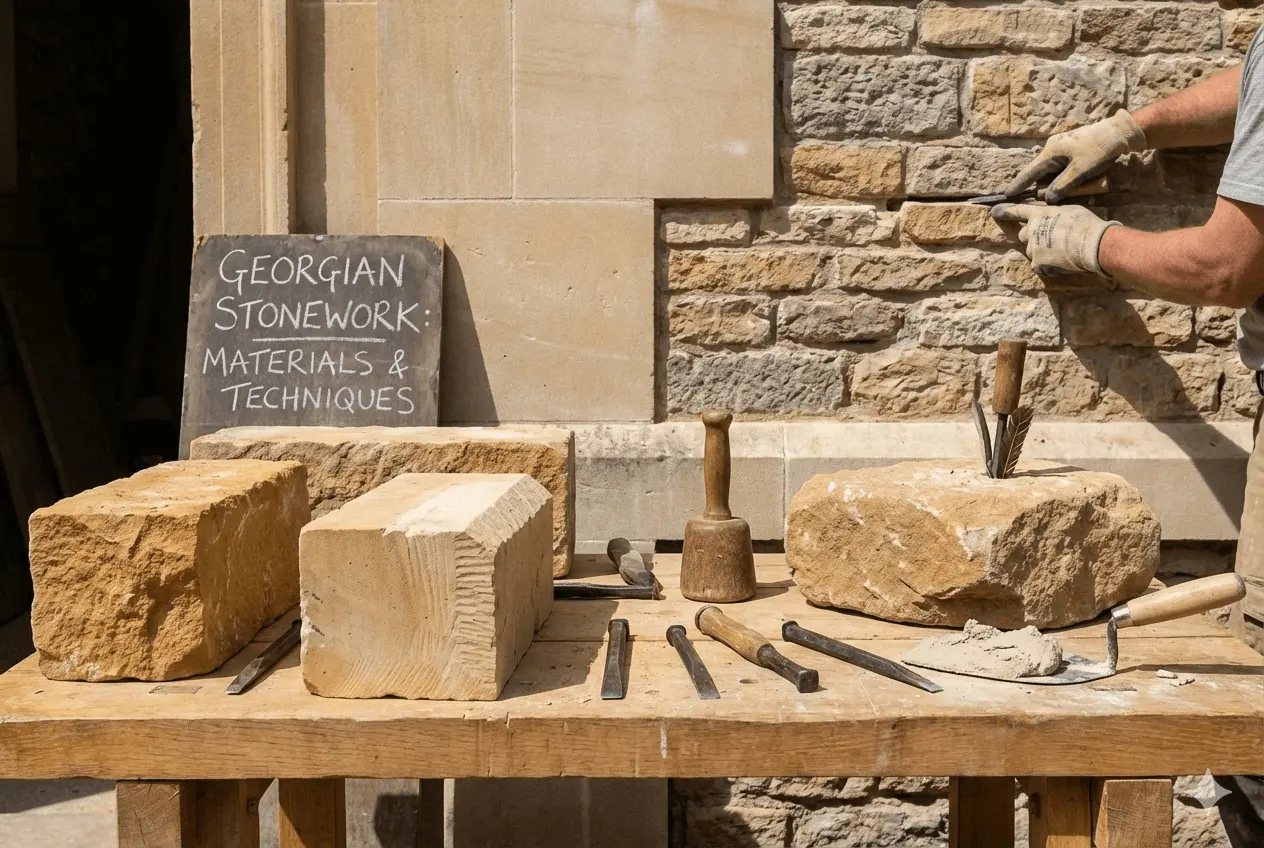
Georgian Stonework: Materials and Techniques
Georgian architecture defines the character of central London, Bath, and Edinburgh, standing as a timeless testament to 18th-century British craftsmanship and classical ideals.
Spanning the reigns of Georges I through IV (1714-1830), the Georgian period reached the zenith of British classical architecture.
It was marked by mathematical precision, superior materials like Portland and Bath stone, and the mastery of ashlar masonry. Georgian buildings are renowned for their elegance, symmetry, and rational proportions.
From London’s elegant squares in Belgravia and Bloomsbury to Bath’s sweeping crescents, the stonework of this era remains as visually captivating and structurally sound today as when it was first crafted.
This guide will explore the signature materials, techniques, and architectural principles that define Georgian stonework and its lasting influence on contemporary restoration.
The Classical Foundation: Proportion and Symmetry
At the core of Georgian architecture lies a strict adherence to mathematical proportions and symmetry.
The obsession with proportion was rooted in the classical ideals of Roman and Greek architecture, specifically those outlined by Andrea Palladio, whose work profoundly influenced the Georgian era.
Palladio’s Four Books of Architecture became the bible for Georgian architects, with their focus on harmony, balance, and regularity.
The influence of the Grand Tour, where young aristocrats traveled through Italy, cemented these classical principles in British architecture. These travelers returned with a strong desire to implement the proportions and elegance of Roman architecture in their own country.
Colen Campbell’s Vitruvius Britannicus (1715) codified these classical principles, while figures like Lord Burlington and William Kent embraced Palladian ideals in their designs.
In Georgian buildings, proportion was everything. Room sizes followed the ‘double cube’ ratio, meaning a room was twice as long as it was wide and high.
Window widths and height ratios, the spacing of columns, and the symmetry of facades all adhered to strict rules derived from the classical orders.
This emphasis on regularity and mathematical balance was mirrored in the stonework: ashlar masonry, with its uniformly cut stones and precise joints, was preferred because it embodied the purity of classical design.
Ashlar’s smooth faces, even courses, and perfectly aligned joints were seen as a reflection of the harmony and order that defined Georgian architecture.
Signature Materials: Portland and Bath Stone
Portland stone and Bath stone are the two defining materials of Georgian stonework, each chosen for its beauty, workability, and durability.
Portland Stone, a fine-grained, creamy-white limestone from the Isle of Portland in Dorset, was highly prized for its durability and ease of carving.
It became London’s signature stone, used in iconic structures like St Paul’s Cathedral, where Sir Christopher Wren set a precedent for its use.
Its smooth texture and ability to take intricate carvings made it perfect for the elegant facades of Georgian buildings, such as those on Regent Street and Portland Place.
Bath Stone, a soft, honey-colored oolitic limestone from Somerset, was more commonly used in smaller buildings and regional projects, notably in Bath’s Royal Crescent and Circus.
Bath stone is softer than Portland stone, allowing for fine details but is more vulnerable to pollution and weathering over time.
While it remains an essential part of Georgian architecture, it can suffer more from erosion due to the elements, especially in cities like London.
These stones were chosen not just for their aesthetic qualities but for their availability and ease of transport via sea or canal. Both stones were durable, able to withstand the test of time for centuries, and were perfect for creating the grand yet accessible designs of Georgian terraces, townhouses, and squares.
In addition to stone, quality brick, often laid in Flemish bond or English bond, was also used for less prominent buildings, with stone used for decorative features like window surrounds, quoins, and string courses.
Ashlar Masonry:
One of the most important techniques in Georgian stonework is ashlar masonry, which involves the use of precisely cut, rectangular blocks of stone laid with razor-thin joints, typically between 3-5mm.
This technique contrasts sharply with rubble masonry, where irregular stones with wide mortar joints were used. Ashlar was preferred for its refinement, creating a smooth and uniform surface that epitomized the Georgian ideals of symmetry and perfection.
The cutting process required highly skilled craftsmen. Banker masons worked in workshops, carefully dressing each stone to exact dimensions using templates, hand tools such as chisels and mallets, and compasses.
Fixer masons, working on-site, were responsible for lifting and positioning the stones, ensuring that they were level, plumb, and securely fixed with lime mortar.
Coursing, the technique of layering stones in horizontal layers of consistent height, was fundamental to ashlar masonry. This method ensured perfect regularity across entire facades.
The uniformity of the stones, together with the precise joints, created a seamless appearance that made the masonry appear as a continuous plane of stone.
This perfection in stonework became a hallmark of Georgian design, reserved for the most prominent facades while more cost-effective rubble masonry was used in foundations and non-visible areas.
Decorative Elements: Rustication, Quoins, and Classical Details
Georgian stonework was not just functional but also highly decorative, though with a restraint that reflected classical ideals.
Rustication, for example, was a technique where stones were given roughened or deeply channel-jointed faces, usually on the ground floor or basement, creating visual weight and grounding the building.
This was often used to differentiate the more rustic basement from the refined piano nobile (main living floor) above.
There were several types of rustication, including smooth-faced with channel joints, banded rustication (horizontal bands of stone alternating between smooth and rusticated), and rock-faced (deliberately rough textures).
These elements added depth and contrast to the facades while maintaining the overall balance and symmetry.
Quoins were another key decorative feature, typically placed at the corners of buildings. These could be alternating large and small stones, sometimes in contrasting colors, emphasizing the building’s strength and structure.
String courses, horizontal bands of stone marking floor levels, were often used to visually divide the facade, emphasizing the building’s horizontal lines.
Other classical elements included window surrounds, with keystones at the top of arches, and pediments, triangular or segmental caps over windows or doors.
Cornices, dentils, and modillions (carved details under cornices) completed the classical aesthetic, requiring master craftsmen to carve and install them precisely.
The Craftsmen: Banker Masons and Fixer Masons
Georgian stonework was made possible by a highly skilled workforce. The work was divided between banker masons, who worked in workshops to cut and carve the stone, and fixer masons, who installed the stones on-site.
Banker masons worked from templates and architectural drawings to cut stones to precise dimensions. They were responsible for shaping the stones, carving intricate details like moldings and capitals, and ensuring that the blocks were uniform in size and shape.
Fixer masons were responsible for transporting these heavy blocks to the building site and positioning them with accuracy. They used tools like the iron lewis (for lifting large stones) and cranes to position stones precisely, ensuring that they were perfectly aligned.
The apprenticeship system was fundamental to this craft. Young apprentices spent several years under the guidance of master craftsmen, learning the techniques necessary to produce the flawless Georgian stonework that still stands today.
Modern Restoration
For modern owners of Georgian properties, maintaining and restoring the original stonework is essential for preserving the building’s historical integrity.
Portland stone is durable and can last centuries, but Bath stone is more vulnerable to weathering, especially in urban environments like London. It is crucial to assess the condition of the stone and address any weathering or erosion before it becomes a larger issue.
Repointing is one of the most important aspects of Georgian stonework restoration. Lime mortar, which was originally used, must be used for repointing rather than modern cement. Cement traps moisture and can cause spalling of the stone.
Matching the original mortar’s color, texture, and joint profile is vital to maintain the building’s historical authenticity.
Stone repairs might involve consolidation treatments for minor damage, dutchmen (stone patches) for more extensive damage, or full replacement of stone if the damage is too severe.
Cleaning the stone requires caution, using methods like DOFF or TORC cleaning, which are gentle and approved for heritage buildings, is necessary to avoid damaging the surface.
Many Georgian buildings are in conservation areas or are listed buildings, meaning that any alterations require listed building consent. Professional heritage masons, skilled in traditional techniques, are essential for these kinds of repairs to ensure that they meet conservation standards.
Conclusion
Georgian stonework represents the pinnacle of classical architecture, blending mathematical precision with masterful craftsmanship.
The use of Portland and Bath stone, the refinement of ashlar masonry, and the subtle yet powerful decorative elements define the elegance and balance of Georgian buildings.
Today, these structures still stand as a testament to the enduring legacy of 18th-century craftsmanship. For owners of Georgian properties, understanding the materials and techniques behind the stonework is essential for maintaining and restoring these architectural treasures.
With the right care, these buildings will continue to grace the streets of London for centuries to come.