Render Removal London Specialists –
Free No-Obligation Site Survey
Fix damp & failing render. Vetted London specialists, free quote.
Quality Guaranteed
Precision, craftsmanship, and a local touch to every project.
One Call Away
We are just a call away. Just dial +442046346617 now.
Diverse Experience
Diverse team of stone masons, diverse exposure.
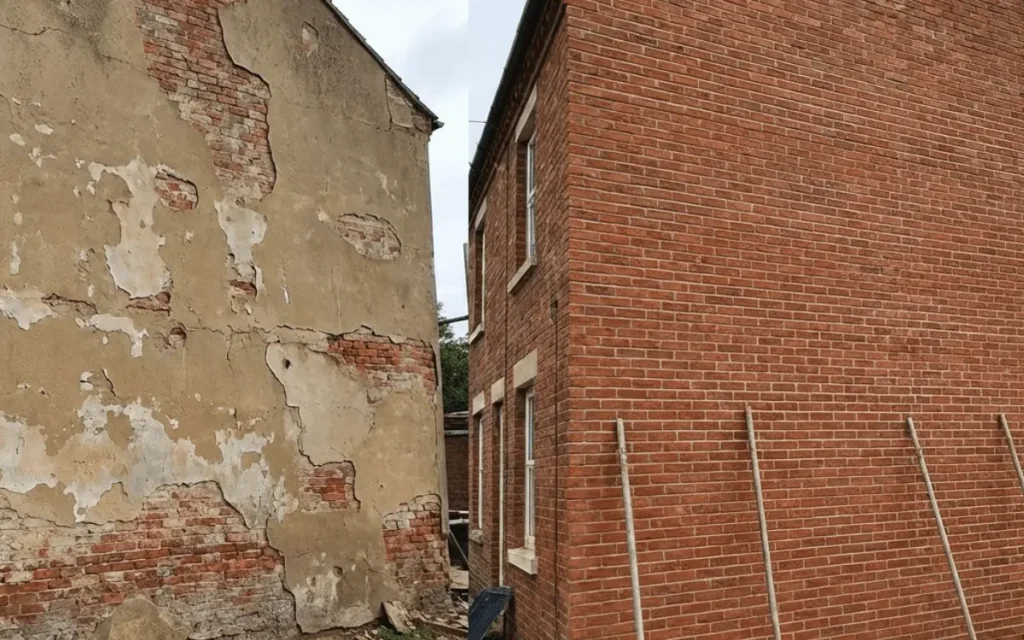
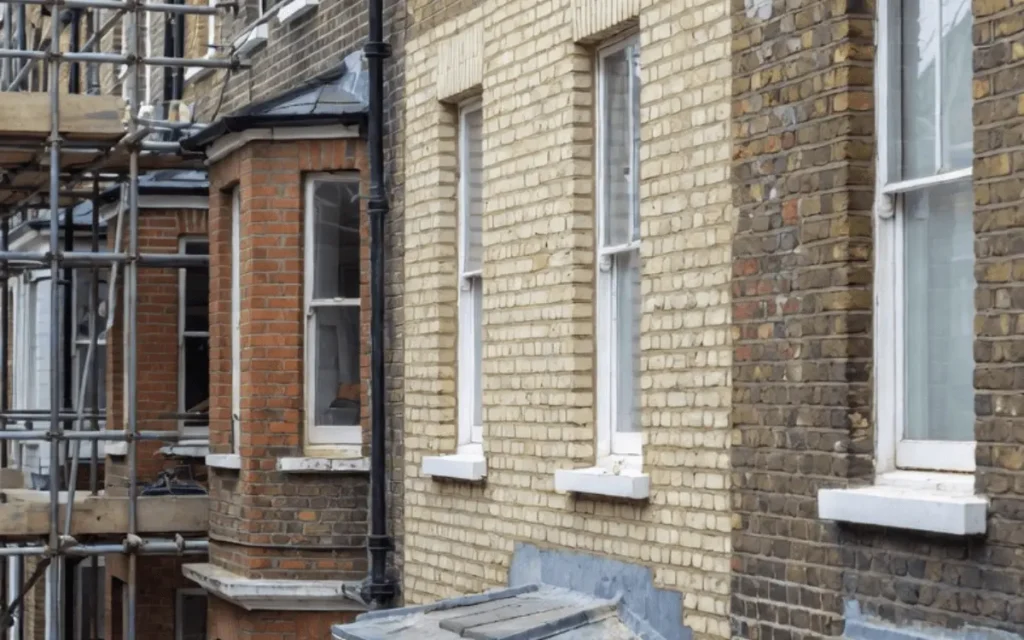
Render removal London is one of the most in-demand property restoration services in London, and for good reason. Across the capital’s Victorian terraces, Edwardian semis, and interwar properties, layers of cement render, pebble dash, and other non-breathable coatings have been applied over the decades.
Moisture is trapped against solid brick walls that were never designed to be sealed. The consequences range from persistent damp and internal mould to accelerated structural decay hidden entirely from view.
Whether your render is cracking and blowing, your property is suffering from damp you cannot get on top of, or you simply want to reveal the original brickwork beneath, get in touch with StoneMasonry London today for a quote.
What Is Render Removal?
Render removal is the process of stripping away an existing exterior coating from the walls of a building, down to the bare brick or stone beneath. Render was historically applied to London properties for a variety of reasons.
Reasons include: to protect soft or irregular brickwork from the elements, to update the appearance of a facade, or simply because it was fashionable at the time. However, the type of render used matters enormously.
When cement-based render or impermeable coatings are applied over (old masonry) lime mortar, the wall can no longer breathe. Moisture becomes trapped behind the coating, leading to frost damage, salt crystallisation (efflorescence), render delamination, and in some cases, significant structural decay.
Render removal corrects this by stripping back the offending coating and allowing the wall to function as originally intended. Depending on the condition of the brickwork revealed, further work such as lime mortar repointing, brick repairs, brick restoration or brick cleaning may also be recommended.
Render Removal London: DIY Signs To Look For
If your property is showing one or more of the signs discussed below, contact us for a free inspection and one of our render removal specialists would visit you.
Early intervention is nearly always more cost-effective than allowing the problem to worsen.
Render problems are not always obvious from the outside, but there are several telltale signs that removal should be considered:
Render Removal London: Our Service Process
Our professional render removal in London follows a structured process to ensure the best possible outcome for your property. Here is what a render removal specialist should deliver:
Initial Site Survey & Assessment
A thorough inspection of the property is carried out to identify the type of render present, assess its condition, and evaluate the likely state of the brickwork beneath.
For older and heritage properties, the risk to the underlying brick face is a key consideration at this stage.
Test Panel
Before full removal begins, we carry out a small panel test in a discreet area of the wall.
This confirms which removal method is most appropriate for your specific render and gives both the specialist and the property owner a clear indication of what the brickwork will look like once exposed.
Area Preparation
The surrounding area is protected before removal begins.
Windows, doors, sills, and any planting or paving are covered with appropriate sheeting to prevent damage from debris and dust.
Render Removal
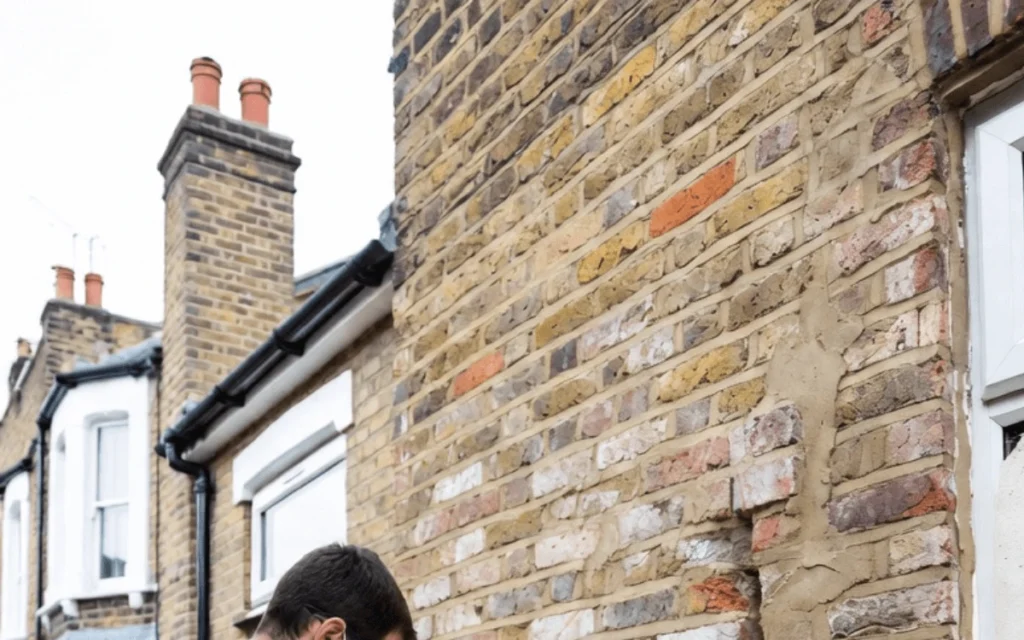
In this step, we manually remove render using hand tools.
We use chisels and scutch hammers for sensitive brickwork, SDS drills or chipping guns for harder cement render, low-pressure steam cleaning (DOFF) to soften stubborn coatings.
We carefully cut decompression lines to prevent the render from pulling away sections of brick face during removal.
Surface Cleaning & Assessment
Once the render is stripped, the exposed brickwork is thoroughly cleaned to remove dust, render residue, and any biological growth.
The mortar joints and individual bricks are then carefully assessed to identify any damage, deterioration, or areas requiring remedial work such as repointing, brick replacement, or crack stitching.
Remedial Works & Final Inspection
Any necessary follow-on works such as lime mortar repointing, brick repairs, or brick tinting to blend repaired areas are carried out before a final inspection is completed.
The site is then cleared and left tidy.
We will walk you through the finished work and advise on maintenance or any further treatment recommended.
Types of Render Found on London Properties:
Not all render is the same, and identifying the type present on your property is an important first step. Specialists working across London regularly encounter the following:
Cement Render (Sand and Cement):
The most common and most problematic type found on older London properties. Sand and cement render is dense and impermeable.
It cracks as the building naturally moves with seasonal temperature changes, and once cracked, allows water in whilst preventing it from escaping.
Cement render removal is the most frequently requested service on period properties across London.
Pebble Dash (Roughcast):
Pebble dash also known as roughcast was widely applied to London properties throughout the 1920s, 1930s, and 1940s.
It consists of a cement mortar base with small stones or aggregate thrown into the wet surface. Like cement render, it is non-breathable and prone to deterioration over time.
Pebble dash removal is a skilled job, as the aggregate can adhere stubbornly and careless removal risks damage to the brick face beneath.
Monocouche & K-Rend
Modern coloured renders such as monocouche and K-Rend are more breathable than traditional cement render and are often applied to newer builds or as part of more recent refurbishments.
When these products fail, typically through poor application, inadequate surface preparation, or impact damage, removal and replacement by a specialist is the recommended course of action.
Lime Render:
Lime render is the historically correct coating for pre-Victorian and Victorian properties.
It is breathable, flexible, and compatible with the original masonry.
If your property has surviving lime render in reasonable condition, we suggest repair instead of removal in some cases.
Render Removal Reviews
Frequently Asked Questions