
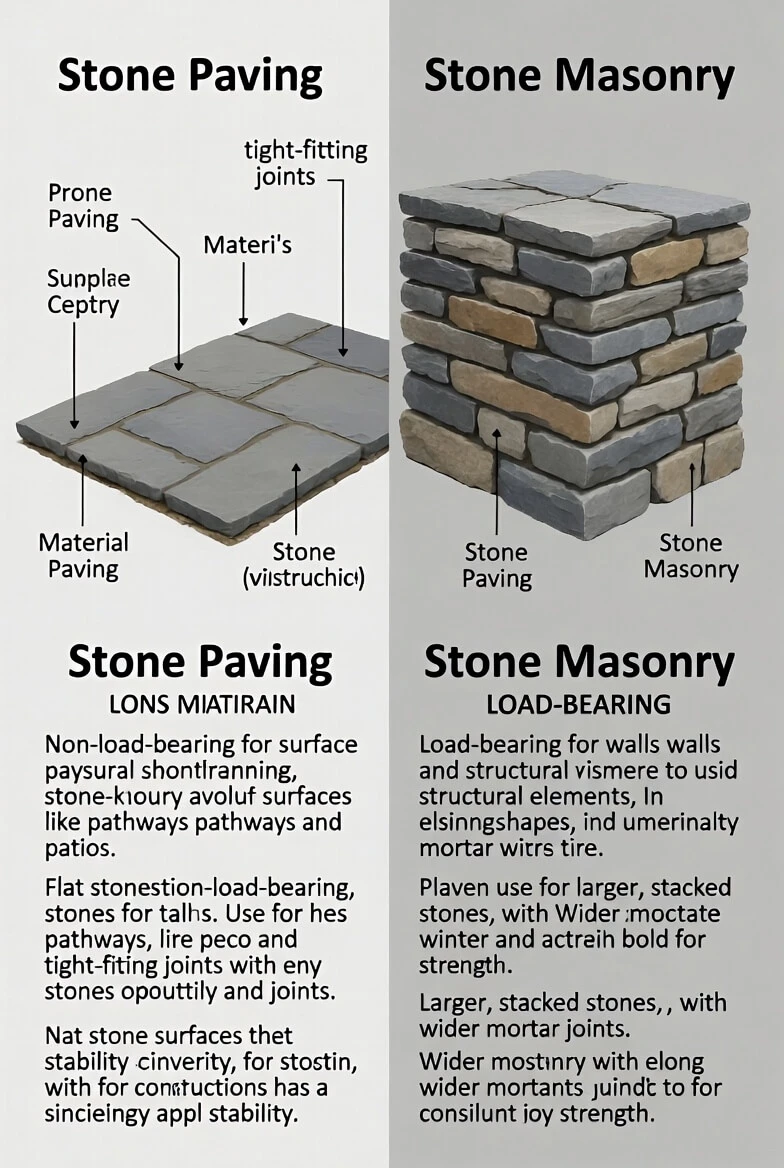
Stone Paving vs Stone Masonry: What’s the Difference
You want stonework done on your London property but do you need a stone mason or a paving contractor? The terms get used interchangeably, but they’re actually distinct crafts serving different purposes.
The fundamental difference is simple: stone paving creates horizontal surfaces (driveways, patios, paths), while stone masonry builds vertical structures (walls, buildings, facades).
Both use natural stone, both require skilled craftspeople, and both create beautiful, lasting results but the techniques, materials, and specialists involved are quite different.
Whether you’re planning a York stone patio, repointing your Victorian terrace, or installing a new driveway, knowing the difference helps you hire the right professional and set the right expectations. Let’s break down what sets these two stonework disciplines apart.
Stone Paving
Stone paving is the art and trade of laying stone on horizontal ground surfaces to create functional, attractive outdoor flooring. Common applications include:
- Driveways: Stone for vehicles to drive and park on.
- Patios and terraces: Outdoor living spaces for dining and entertaining.
- Garden paths and walkways: Connecting different areas of your property.
- Courtyards: Enclosed paved areas for socializing or relaxation.
- Pool surrounds: Slip-resistant stone around swimming pools.
- Steps: The horizontal treads (though step construction can involve masonry too).
Paving serves both practical purposes (bearing foot and vehicle traffic, managing surface water) and aesthetic goals (enhancing landscape design, creating outdoor living spaces). It’s a key element of “hardscaping”, the non-plant elements of landscape architecture.
In Britain, stone paving has deep roots. York stone paved London’s streets, station platforms, and Georgian squares. Victorian and Edwardian gardens featured flagstone paths and terraces. Today, natural stone paving remains the gold standard for high-quality outdoor spaces.
Common Paving Materials
Common paving materials include:
- Natural stone: York stone, Indian sandstone, limestone, granite, slate.
- Flagstones: Large, flat stone slabs, classic for British patios and paths.
- Cobbles and setts: Small, cube-shaped stones for driveways and decorative areas.
- Concrete pavers: Manufactured alternative, often designed to mimic natural stone.
- Porcelain pavers: Modern option with high durability and low maintenance.
Natural stone remains the premium choice for quality, longevity, and timeless aesthetics.
Stone Masonry
Stone masonry is the ancient craft of constructing vertical structures like walls, buildings, architectural features using stone bonded together with mortar. Common masonry applications include:
- Building walls: Load-bearing walls that form the structure of houses, commercial buildings.
- Facades and cladding: Stone “skins” on building exteriors (like Portland stone on London townhouses).
- Garden and boundary walls: Freestanding walls defining property boundaries.
- Retaining walls: Walls holding back earth on slopes.
- Columns and pillars: Vertical supports for structures.
- Arches: Curved structural features over windows, doorways, bridges.
- Chimneys: Stone chimney stacks.
- Restoration: Repairing and maintaining historic stonework.
Masonry is fundamentally structural and architectural i-e it creates buildings and the vertical elements within landscapes. From the pyramids to Gothic cathedrals to Georgian London, stone masonry has shaped human civilization’s most enduring architecture.
Masonry Techniques and Types
Main masonry techniques include:
- Ashlar masonry: Precisely cut, uniform rectangular stone blocks with thin mortar joints i-e grand buildings like Bath’s Georgian crescents.
- Rubble masonry: Irregular, roughly shaped stones with wider joints like rustic garden walls, old cottages.
- Coursed masonry: Stones aligned in horizontal layers.
- Uncoursed/random: Stones placed without uniform layers.
The technique chosen depends on stone availability, building purpose (structural vs decorative), and aesthetic goals.
The Key Differences
Let’s clarify the core differences:
- Orientation: Paving = horizontal surfaces (ground level). Masonry = vertical structures (walls, buildings).
- Primary purpose: Paving = functional ground surface + landscape aesthetics. Masonry = structural support + architectural enclosure.
- Installation approach: Paving sits on a prepared sub-base (crushed stone, sand bed, compaction). Masonry rises from foundations with footings to support weight.
- Load-bearing: Paving bears foot traffic, vehicles, furniture. Masonry bears building loads which includes roofs, floors, live loads.
- Jointing: Paving uses sand-filled joints (flexible) or mortar joints (rigid). Masonry uses mortar to bond stones structurally.
- Drainage: Paving must allow surface water to drain away (falls, permeable joints). Masonry must prevent water from penetrating walls (pointing, DPCs).
- Specialists: Paving = paving contractors, landscape masons, hardscape specialists. Masonry = stonemasons, building masons, heritage specialists.
- Typical projects: Paving = driveways, patios, garden paths, courtyards. Masonry = house walls, facades, garden walls, chimneys.
The simple test: If it’s on the ground and you walk/drive on it, it’s paving. If it’s standing up and forms a structure, it’s masonry.
Where They Could Be Similar: Shared Elements
While distinct, paving and masonry share common ground:
- Materials: As I mentioned earlier, both use natural stones like limestone, sandstone, granite, York stone, slate. The stone types overlap, though sizing differs (pavers are typically flat slabs; masonry uses blocks).
- Stone cutting: Both require cutting, shaping, and dressing stone to fit.
- Mortar and pointing: Both can involve mortaring stones and filling/finishing joints (though paving also uses dry-laid techniques with sand joints).
- Maintenance: Both need periodic repointing, cleaning, and sealing to maintain appearance and integrity.
- Skills: Craftspeople in both trades need a good eye for stone, understanding of material behavior, precision, and patience.
Some masons handle both, especially for smaller projects like garden walls with integrated patios. And certain features like steps can involve both disciplines: masonry for the structure (risers, retaining), paving for the treads.
For complex projects, say, a new garden with retaining walls, steps, and patio, you might need both a stonemason and a paving contractor, or a firm that handles both.
Which One Do You Need? Decision Guide
Choose stone paving when you’re working on the ground:
- Installing a new driveway
- Creating a patio or terrace for outdoor dining/entertaining
- Laying garden paths or walkways
- Resurfacing a courtyard
- Building a pool surround
- Replacing worn flagstones
Choose stone masonry when you’re building vertically:
- Constructing or repairing walls (house, garden, boundary, retaining)
- Restoring a stone facade on a Georgian or Victorian building
- Repointing deteriorating mortar on period property walls
- Building a chimney, column, or arch
- Creating garden features that stand up (pillars, gateways)
You may need both for:
- Terraced gardens (retaining walls + paved levels)
- Outdoor kitchens (masonry structure + paved floor)
- Steps (masonry risers/structure + paved treads)
- Courtyards with enclosing walls
When hiring, ask: “Do you specialize in paving or masonry work?” Some contractors do both; others focus on one. For major projects on heritage buildings, you’ll want a stonemason with conservation experience. For landscape paving, a paving contractor or landscape mason is your specialist.
London Examples: Seeing the Difference
Walk around London and you’ll see both disciplines everywhere:
Stone paving examples:
- York stone paving in Covent Garden piazza
- Flagstone garden patios behind Victorian terraces
- Cobbled mews in Kensington and Notting Hill
- Paved squares from Bloomsbury to Islington
Stone masonry examples:
- Portland stone facades on St Paul’s Cathedral and government buildings
- Georgian townhouse walls throughout Bloomsbury, Marylebone, Belgravia
- Victorian mansion block exteriors
- Brick and stone boundary walls throughout residential neighborhoods
- Bath stone window surrounds and architectural details
Conclusion
Whether you’re planning a York stone patio, repointing your Georgian terrace, or creating a garden with walls and paths, knowing which discipline you need helps you hire the right tradesperson, set appropriate expectations, and get quality results.
If you’re walking on it, it’s paving. If it’s standing up, it’s masonry. Armed with that knowledge, you’re ready to plan your next stonework project with confidence.