
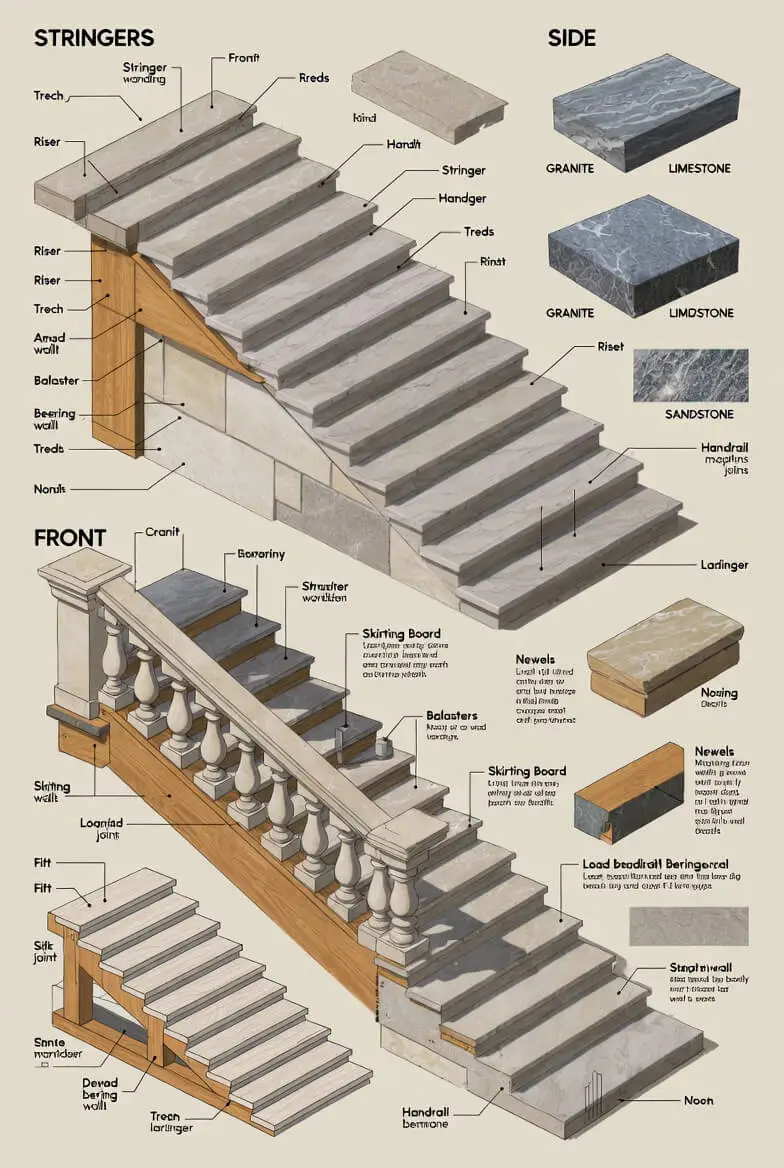
Stone Staircases: Construction and Design Principles
Stone staircases do double duty in landscape and architectural design, they solve practical elevation challenges and add sculptural beauty and character.
Beautiful stone staircases don’t happen by accident. They require thoughtful design (comfortable rise and run, proper drainage, safety features) and solid construction (adequate foundations, appropriate materials, weatherproof jointing).
Get it right and you’ll have steps that last generations. Get it wrong and you’ll face uneven treads, premature settling, or worse, dangerous trips and falls.
This guide covers the fundamental principles of stone stair design and construction, from Victorian garden paths to contemporary landscape features, helping you plan steps that are safe, durable, and beautiful.
Design Fundamentals: Rise, Run, and Comfort
The Golden Ratio: Rise and Run
The foundation of any well-designed staircase is the rise and run, the two dimensions that determine comfort and safety:
- Rise: The vertical height of each step (the riser). For outdoor stone stairs, aim for 6-8 inches (150-200mm). Outdoor steps can be gentler than indoor (where 7-8 inches is standard).
- Run: The horizontal depth of each tread. Minimum 11-14 inches (280-350mm) ensures your whole foot fits comfortably, not just your toes.
The traditional formula for comfortable stairs:
2 × rise + run = 24-27 inches (61-69 cm). So a 7-inch rise pairs with a 12-inch run. A 6-inch rise pairs with 14 inches.
Critical: Keep rise consistent throughout. Even a half-inch variation between steps creates a trip hazard. Your brain learns the rhythm of climbing; irregular steps break that rhythm. Use a story pole or consistent measurement for every riser.
Outdoor stairs tend toward the gentler end—6-inch rises with generous 14-inch treads create leisurely garden steps. Front entrance stairs might be 7 inches for a more formal, architectural feel.
Width, Landings, and Safety
- Width: Minimum 3 feet (900mm) for functional single-person stairs. Main entrances or frequently used garden stairs benefit from 4-5 feet (1.2-1.5m).
- Landings: For long staircases, add a landing every 12-15 steps (roughly 5-6 feet of elevation gain). Landings provide resting points and visually break up long climbs. Minimum depth: 3 feet.
- Safety features: Handrails required for stairs with 4+ risers (check local building codes). Add low-voltage lighting for evening use. Choose textured stone or tooled finishes for slip resistance.
Construction Methods: Dry Stone vs Mortared
Dry Stone Steps
Dry stone construction stacks stones without mortar, relying on careful placement, gravity, and interlocking to create stability. Two main approaches:
- Treads and risers: A 4-inch thick stone forms the riser (vertical face). On top sits a 2-inch flagstone tread. Each step’s riser rests on the tread below.
- Boulder/big block steps: Massive 6-7 inch thick stone slabs laid so each overlaps the one beneath it. Classic, robust appearance.
Stability comes from overlap and weight. Each stone bears on the step below, transmitting load to the foundation. Steps embedded into adjacent walls gain additional support.
The ‘kick test’: A well-built dry stone step won’t budge when kicked. If it moves, it’s not stable enough.
Advantages: Breathable (no mortar to trap moisture), repairable (individual stones replaceable), traditional aesthetic, no mortar deterioration.
Best for: Garden steps, rustic settings, slopes with good drainage. Requires larger stones and a skilled stonemason.
Mortared Construction
Mortared construction bonds stones with cement mortar, creating a monolithic structure.
Typical method: A concrete block inner structure provides strength. Stone veneer adheres to the blocks with mortar, or flagstone treads are set on a mortar bed.
Mortar mix: 1 part cement to 3 parts sand, mixed to workable consistency. ‘Butter’ (liquid mortar, consistency of pea soup) is poured between dry-set stone and bed for maximum adhesion.
Order of installation: Risers first, then treads, then borders/edging.
Advantages: Works with smaller stones, higher load capacity, suitable for formal front entrances, compatible with architectural styles.
Limitations: Mortar vulnerable to freeze-thaw if water penetrates joints. Requires eventual repointing. Use recessed joints (mortar set back slightly from stone face) to reduce weather exposure.
Best for: Front entry stairs, high-traffic areas, formal designs, integration with building architecture.
Foundation Requirements
Stone staircases are only as good as their foundations. Cut corners here and even beautiful steps will settle, crack, or fail.
For mortared stairs: Pour a concrete footing below the frost line—typically 18-30 inches deep in the UK. This prevents frost heave from lifting and cracking the structure. Build concrete block foundation from footing to grade level, then construct steps atop this base.
For dry stone stairs: Excavate and create a compacted gravel base (6-12 inches deep). Well-draining, stable, prevents settling.
Critical mistake: Starting steps partway up a slope. Water and traffic erode the ground beneath the bottom step, undermining the entire staircase. The bottom step must rest on a solid, excavated footing, not dirt or existing paving. If building against bedrock, pin the bottom step to the rock.
Existing concrete steps? They can be veneered with stone, provided the base is sound. Inspect for cracks, settling, or structural issues first.
Proper foundation work isn’t exciting, but it’s the difference between steps that last decades and steps that fail in five years.
Material Selection for Different Applications
Material selection depends on aesthetic, budget, and traffic:
- Bluestone: The classic choice. Dense, durable, naturally slip-resistant, blue-grey color. Excellent for treads in high-traffic areas.
- Limestone: Creamy whites and tans, elegant for formal entrances. Softer—best for moderate-traffic garden stairs.
- Granite: Extremely hard, handles heavy traffic, vehicles. Choose textured (thermal-finished or flamed) not polished.
- Sandstone: Warm reds, yellows, browns. Good natural grip. Moderately durable.
- York stone: Traditional UK paving stone, honey-colored, slip-resistant, timeless in London gardens.
- Slate: Dark grey-black, fine-grained, naturally grippy. Sophisticated appearance.
- Fieldstone/boulders: Rustic, irregular shapes for dry stone construction. Natural, organic look.
Surface texture matters: Avoid polished stone on treads (dangerously slippery when wet). Choose textured, thermal-finished, or naturally rough surfaces.
Thickness: Flagstone treads minimum 2 inches. Riser stones 4-6 inches. Boulder steps 6-7 inches thick.
Drainage and Weatherproofing
Water management makes or breaks stone staircase longevity:
- Forward pitch: Treads should slope forward very slightly (1-2%) to shed water. Standing water accelerates freeze-thaw damage.
- Permeable joints: Dry stone steps naturally drain through open joints. Mortared steps need weep holes i-e small gaps in mortar allowing water escape.
- Avoid water traps: Platforms and top treads must drain. No pooling. Center platforms with 4″ concrete and border with coping stones that overhang slightly.
- Critical: Never use pavers on stair platforms. Pavers have small joints meant for gravel beds. On stair platforms, these joints allow water penetration into the structure, causing freeze-thaw damage and shortened lifespan.
- Side drainage: Steps shouldn’t channel water downward like a gutter. Install swales or drainage alongside to divert runoff.
In freeze-thaw climates (like the UK), trapped water + winter temperatures = cracked stone and mortar failure.
London’s Period Properties and Gardens
Stone staircases are woven into London’s architectural fabric:
- Front entrances: Victorian and Georgian townhouses across Bloomsbury, Kensington, Marylebone feature stone or brick steps leading to raised ground floors—often with iron railings, stone copings, elegant proportions.
- Garden terraces: London’s hilly neighborhoods (Hampstead, Richmond, Highgate) feature terraced gardens with stone steps connecting levels. York stone remains the traditional choice, blending seamlessly with period aesthetics.
- Conservation considerations: Listed buildings or conservation areas may require planning consent for exterior alterations, including staircase changes. Match original materials and style when repairing or replacing.
- Modern London gardens: Even contemporary landscapes benefit from stone staircases—timeless, durable, and increasing property value.
Thoughtful stone step design respects architectural context while solving practical elevation challenges.
Conclusion
Stone staircases combine engineering, craftsmanship, and artistry. Get the fundamentals right, comfortable rise and run (6-8 inches × 11-14 inches), solid foundations below frost line, appropriate materials for surface and use, effective drainage, and you create steps that serve safely and beautifully for generations.
Stone steps are one of landscape and architecture’s most enduring elements. Build them well, and they become a permanent asset, functional, beautiful, and utterly timeless.