
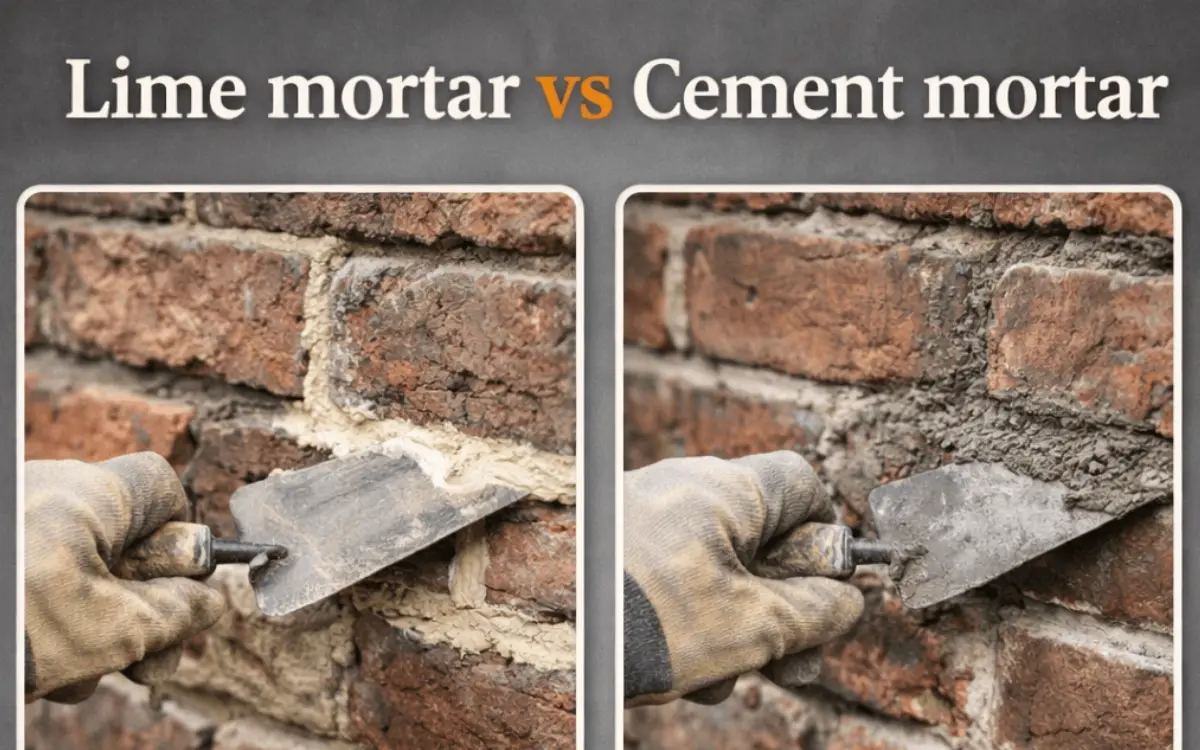
Lime mortar vs cement mortar – user’s guide 2026
Choosing the right mortar is crucial to restore or maintain your historical property in London. Many homeowners with Victorian and Edwardian buildings face the dilemma of whether to use lime mortar or cement mortar for repointing and restoration.
This decision is especially important for the longevity and health of your building’s masonry. In this article, we will talk about the differences between lime mortar and cement mortar.
I will try to highlight the key factors that make lime mortar the ideal choice for historic London properties.
Lime Mortar Explained
Lime mortar is one of the oldest building materials, used for thousands of years in the construction of ancient Roman buildings and beyond. It is made from limestone, which is heated and mixed with water to create slaked lime.
This mixture is then combined with sand or aggregates to form mortar. There are different types of lime mortar, each with its own unique properties:
Types of Lime Mortar
- NHL 2: A softer, more flexible lime mortar, often used for general purposes.
- NHL 3.5: The most common and versatile type, used for general masonry work.
- NHL 5: A stronger lime mortar, ideal for exposed areas where additional durability is required.
- Non-hydraulic Lime (Putty Lime): This is the most flexible type, often used in restoration projects for its superior elasticity.
How Lime Mortar Works
Lime mortar sets through a process known as carbonation, where the lime absorbs carbon dioxide (CO2) from the air.
Unlike cement, which sets through a chemical reaction with water, lime mortar’s setting process is slower, taking several days or even weeks to harden. Over time, lime mortar continues to cure and harden as it absorbs more CO2, a process that can take months.
Key Properties of Lime Mortar
- Breathability: Lime mortar allows moisture vapor to pass through the walls, preventing damp and mold buildup.
- Flexibility: Its elasticity enables it to accommodate the natural movement of buildings, which is essential for old properties that settle and shift.
- Self-healing: Lime mortar can “heal” small cracks by absorbing CO2 from the air, making it a durable and sustainable option for historic buildings.
Cement Mortar Explained
Cement mortar, specifically Portland cement, was invented in 1824 by Joseph Aspdin. This revolutionary material quickly became the standard for modern construction due to its strength and durability.
Cement mortar is made by mixing Portland cement with water and aggregate.
How Cement Mortar Works
Unlike lime mortar, cement mortar sets through hydration, a chemical reaction between cement and water. This process happens quickly, allowing the mortar to harden in just a few hours.
However, it continues to gain strength for up to 28 days, reaching its full compressive strength within this period.
Key Properties of Cement Mortar
- Strength: Cement mortar provides high compressive strength, making it ideal for modern structural applications.
- Speed: It sets rapidly, allowing for quicker construction and repair work.
- Hardness: Once cured, cement mortar is rigid and inflexible, offering a solid, durable surface. However, it can crack under building movement.
Key Differences: Lime vs Cement Mortar
|
Category |
Lime Mortar |
Cement Mortar |
|---|---|---|
|
Setting Process |
Sets through carbonation (absorbing CO2 from the air) |
Sets through hydration (chemical reaction with water) |
|
Setting Time |
Takes days to weeks to set, with months required for full cure |
Sets in hours, with full strength reached in 28 days |
|
Strength & Hardness |
Softer, more flexible with lower compressive strength |
High compressive strength, hard, and rigid |
|
Breathability |
Highly breathable, allowing moisture vapor to pass through |
Non-breathable, traps moisture inside walls |
|
Flexibility |
Accommodates movement, elastic, and can “heal” small cracks |
Rigid and brittle, prone to cracking under building movement |
|
Durability |
Self-healing and sacrificial, lasting for centuries |
Very durable, but can cause damage to masonry if used incorrectly |
|
Environmental Impact |
Absorbs CO2, low carbon footprint |
High carbon emissions, energy-intensive production |
|
Cost |
More expensive, labor-intensive to apply |
Cheaper, faster, and readily available |
|
Appearance |
Natural texture and color variations, softer aesthetic |
Uniform, smooth finish |
|
Building Compatibility |
Ideal for soft brick and historic buildings (pre-1920s) |
Best for modern construction with hard bricks |
When to Use Lime Mortar
Lime mortar should be used when restoring or maintaining any pre-1920s buildings in London, particularly those made of soft brick such as London stock brick.
This includes Victorian, Edwardian, and Georgian properties. If your property is listed or located in a conservation area, lime mortar is often required by law due to its compatibility with historic materials.
Lime mortar is perfect for buildings experiencing damp issues. Its breathability allows moisture to escape, preventing condensation and long-term damage.
When repointing historic properties, lime mortar’s flexibility and self-healing properties make it the ideal choice for maintaining the structural integrity of the original brickwork.
When to Use Cement Mortar
Cement mortar is suitable for modern construction or post-1920s buildings. If your property is made from hard brick or engineered brick, cement may be the better choice due to its strength and ability to withstand high load-bearing requirements.
Cement mortar is also ideal for areas such as foundations, chimneys, or external exposed areas where durability is a priority and breathability is not a concern.
Problems with Using the Wrong Mortar
Using the wrong mortar for your historic building can lead to serious damage. For example, using cement mortar on Victorian properties can result in moisture being trapped inside the walls.
This can cause damp problems, including mould, efflorescence, and spalling—a process where moisture freezes inside the brick and causes the surface to pop off. Over time, this can cause irreversible damage to the original masonry and be very costly to repair.
In addition to structural damage, using the wrong mortar can violate local conservation regulations, especially if the property is listed or in a conservation area. This could lead to fines or complications with selling the property.
Lime Mortar Repointing in London: Why It Matters
For London homeowners with Victorian and Edwardian properties, lime repointing is an essential part of building restoration.
Many historic properties were repointed with cement mortar during the 1960s-1980s, which has now caused significant issues such as spalling and damp problems.
Lime repointing is the best solution for restoring these properties, as it is compatible with the original materials and helps to preserve the structure’s breathability.
Using a professional lime repointing service ensures that the mortar applied matches the original composition and strength of the original material.
As heritage specialist, StoneMasonry London team understands the specific requirements for London’s listed buildings and conservation areas, and can help you achieve a period-appropriate restoration that maintains your property’s value and structural integrity.
Contact us for a free survey and expert advice on how lime repointing can protect your investment.
Conclusion
Choosing the right mortar is crucial for the long-term health of your property.
For Victorian, Edwardian, and other period properties in London, lime mortar is the clear choice, offering breathability, flexibility, and self-healingproperties that cement simply cannot provide.
If you’re unsure which mortar is right for your project, contact us today for a free property survey and expert advice
Related Posts:
Common Stonemasonry Problems in London Properties
Stonemasonry vs Brick Masonry
What Does A Stonemason Do?
Difference Between Brick Repairs and Brick Restoration
When Did Stonemasonry Begin