
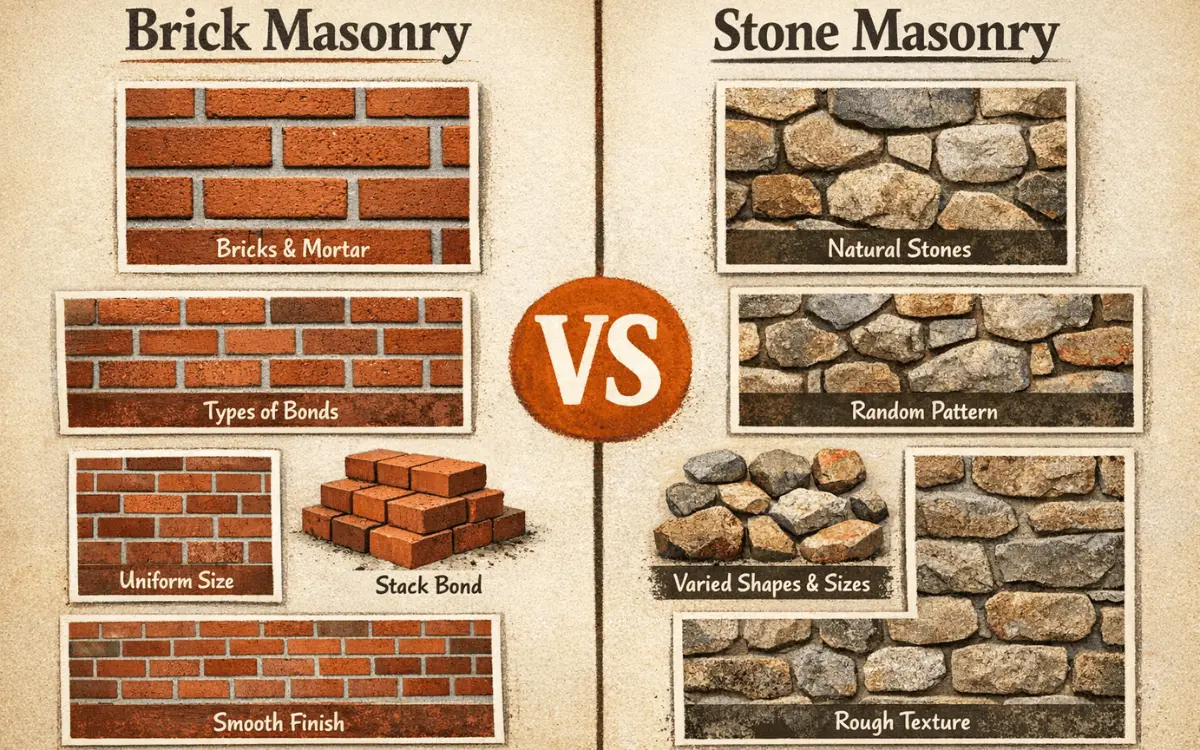
Stone Masonry vs Brick Masonry – Learner’s Guide 2026
When it comes to choosing the right materials for building or renovation projects, we have two prominent options: stone and brick. Both have been used for centuries to shape the buildings we see and admire today.
From ancient monuments to modern homes, either stones or bricks were used. However, they offer distinctive benefits in terms of durability, overall appearance, and cost.
In this post, we’ll compare stone masonry and brick masonry by highlighting the key differences to help property owners in London make better decisions about which option would best suit their needs.
WHAT IS STONE MASONRY?
Stone masonry is a traditional craft where skilled stonemasons work with natural quarried stone to build structures either for residential or commercial projects.
We, at StoneMasonry London, commonly use stone types including limestone, granite, sandstone, Portland stone, and Bath stone. These stones are either cut into uniform blocks (known as ashlar masonry) or left in their natural, irregular form (known as rubble masonry).
Stone masonry has deep historical roots. For example structures like ancient temples, castles, and bridges showcase the timeless beauty and strength of stonework.
The durability of stone masonry is one of its strongest attributes. Natural stone is an ideal material for buildings which are more exposed to weathering or pollution because of its weather-resistant properties.
Today, stone masonry also plays a key role in heritage restoration, where the focus is to preserve historical structures, maintain their authenticity, and restore the original beauty of the building.
Stonework is often used in the construction of monuments and prestigious buildings, including churches, cathedrals, and public landmarks. Also read “What does a stone mason do” for more details.
WHAT IS BRICK MASONRY?
Brick masonry, on the other hand, involves the use of fired clay bricks as the main building material. Bricks are comparatively easier to handle and install because they are easily available in uniform size and shape.
Brick masonry just like stone masonry involves using a bonding agent i-e mortar, which acts as a sealant or binder to hold the bricks together.
Bricks have been in extensive use since the Industrial Revolution. They are a mass-produced, affordable and versatile building material. The most common types of bricks include red bricks, yellow bricks, London stock bricks, and engineering bricks, which are fired in kilns to create durable, uniform building units.
The widespread availability and relatively low cost of brickwork makes it a go-to choice for many construction projects. Additionally, brickwork provides a wide range of affordable design options, which are not easily available in case of stonework.
Key Differences Between Stone Masonry and Brick Masonry
|
Category |
Stone Masonry |
Brick Masonry |
|---|---|---|
|
Material |
Natural, quarried stone (e.g., granite, limestone, sandstone) |
Manufactured, fired clay bricks (e.g., red, yellow, London stock) |
|
Appearance |
Unique textures, varied colors, natural beauty |
Uniform, standardized, typically red or yellow |
|
Durability |
Extremely durable (well built structure easily lasts centuries, some with proper maintenance may even last 1000-2000+ years) |
Less durable (usually 50-100 years) |
|
Strength |
Very high compressive strength, ideal for heavy load-bearing structures |
Good strength but not as high as stone |
|
Weight |
Very heavy (thick walls, high dead load) |
Lighter, easier to handle (thinner walls) |
|
Cost |
Expensive, higher labor costs |
Economic, cost effective |
|
Availability |
Limited, less accessible |
Widely available, mass-produced |
|
Construction Time |
Slower, requires skilled craftsmen |
Faster, easier to install, comparatively less labor-intensive |
|
Design Options |
Wide variety of natural designs, custom shapes |
Limited design options (but versatile in patterns) |
|
Maintenance |
Low maintenance, expensive repairs |
Requires more frequent repairs (e.g., plastering) |
WHEN TO USE STONE
Stone masonry is ideal for certain types of construction, particularly in case of heritage preservation. Here are the situations where stone is suitable to be used:
- Heritage and Historic Buildings: Stone is often the material of choice for the restoration of listed buildings, monuments, and other historic structures in London.
- Prestigious Structures: For buildings like churches, cathedrals, and museums, stone offers an unmatched sense of stability and distinction.
- Foundations: Stone’s ability to withstand harsh weather conditions makes it an excellent material for foundations and structures exposed to water, such as piers or quay walls.
- High-Traffic Public Buildings: Stone is highly durable and can handle wear and tear. It can be a suitable choice for buildings like government buildings, public squares, and transport hubs.
- Conservation Areas: When working in conservation areas or listed properties, using stone is often required to comply with heritage regulations.
WHEN TO USE BRICK
Brick is an excellent choice for residential or modern construction projects. Lets explore when opting for brickwork can be a wise option:
- Residential Buildings: Bricks are a cost-effective solution for modern homes. Their versatility and ease of use make them a popular choice for residential construction.
- Budget-Constrained Projects: For projects where budget is a concern, brickwork comparatively offers an economical and durable solution.
- Quick Construction Needs: Brick is quicker to install than stone. Its ideal for projects with tight timelines.
- Fire-Resistant Requirements: Brick has excellent fire resistance. So for fire rated buildings like apartment buildings brickwork is a more suitable option.
- Standard Construction: For contemporary commercial or industrial buildings, brick provides a strong and affordable material that meets structural requirements without the need for premium costs.
Advantages & Disadvantages of Stone Work and Brick Work
Stone Masonry Pros:
- Durability: Stone can last for centuries, withstanding weathering and natural wear.
- Aesthetic Appeal: Each stone is unique, adding natural beauty to structures.
- Weather Resistance: Stone is highly resistant to moisture, frost, and extreme weather.
- Prestige: Stone is often used in iconic buildings, adds to prestige and grandeur.
- Low Maintenance: Once installed, stone requires minimal upkeep.
Stone Masonry Cons:
- Cost: Stone is expensive, and working with it requires highly skilled craftsmen.
- Weight: The heavy nature of stone requires strong foundations and thicker walls.
- Time-Consuming: Construction with stone takes longer, which increases the labor cost.
- Limited Availability: Natural stone can be more difficult to source and transport.
- Difficult to Alter: Once a stone structure is built, making modifications can be challenging.
Brickwork Pros:
- Cost-Effective: Brick is cheaper than stone, suitable for large-scale or budget-conscious projects.
- Lightweight: Brick is lighter than stone.
- Quick Construction: Bricks are easier and quicker to lay than stones, which reduces labor costs.
- Easy to Work With: Bricks are easier to cut, shape, and modify.
- Fire Resistance: Brick is naturally fire-resistant, offers increased safety.
Brickwork Cons:
- Durability: Bricks have a shorter lifespan than stone, but its good enough if we don’t compare it with stone.
- Maintenance: Bricks are more susceptible to weathering and require regular repointing and plastering.
- Limited Aesthetics: Bricks have fewer design options compared to stone’s natural variations.
- Vulnerability to Moisture: Bricks can absorb moisture, which can lead to damage over time.
Usage of Stone/Bricks in London
- Georgian (1714-1830): During the Georgian period, yellow London stock bricks became popular for symmetrical terraces and stucco-rendered facades to mimic stone.
- Victorian (1837-1901): With industrialization, the use of red brick became common, though stone continued to be used for prestigious public buildings and monuments (e.g., Houses of Parliament).
- Edwardian (1901-1914): Brick remained common in residential construction.
- Stone: Key historical landmarks like the Tower of London, Westminster Abbey, and St Paul’s Cathedral were constructed using stone. These iconic structures showcase the longevity and endurance of stone.
- Brick: The vast majority of Victorian and Edwardian terraced houses in London’s boroughs are built with brick. Brickwork defines much of London’s residential streetscape.
CONCLUSION
In the debate between stone masonry and brick masonry, it is fair to say that each material offers unique advantages depending on the project.
Stone is durable, prestigious, and ideal for heritage and monumental buildings, while brick is versatile, economical, and better suited for both residential and commercial construction.
When working on London properties, understanding the historical context and the material requirements is essential. So whether you need stone restoration or brick repairs in London, professional guidance is important to ensure that the right material is used.
Related Posts:
Common Stonemasonry Problems in London Properties
Difference Between Brick Repairs and Brick Restoration
Lime Mortar vs Cement Mortar
Common Brick Repointing Mistakes